
Niche Selection — Affiliate Marketing Basics
How to Choose a Niche for Affiliate Marketing (Honest Beginner's Guide)
Published: 11th May 2026 · 8 min read
If you've looked into affiliate marketing for more than five minutes, you've probably hit the same wall everyone hits. "Pick a niche." Easy to say. Harder to actually do.

Every niche journey starts with a choice. The good news is there's no single right answer — just the one you commit to and build on.
Wealthy Affiliate walks you through niche selection as part of its free beginner training — from picking your niche to building traffic.
Affiliate disclosure: NomadAffiliate.co may earn a commission if visitors sign up using affiliate links, at no extra cost to them.
Most beginners either spend weeks overthinking it — cycling through ideas, second-guessing everything — or they rush into something that sounds profitable but ends up going nowhere.
Neither approach works. This guide is going to walk you through how to actually choose a niche that makes sense for you, without the usual hype or the pressure to "pick the hottest topic of 2026." Let's keep it simple and practical.
What Is a Niche, Really?
A niche is just a specific topic your website or content is focused on.
It's not a vague category like "health" or "money." It's a focused area within that category — something like "meal prep for people over 50" or "budget travel in Southeast Asia" or "beginner home recording studios."
The more focused your niche, the easier it is to attract the right readers, rank in search engines, and eventually promote products your audience actually wants.
Broad niches are competitive. Specific niches give you a fighting chance.
The 3 Things a Good Niche Needs
Before you start brainstorming ideas, it helps to know what you're looking for. A solid affiliate marketing niche generally has three things:
1. An audience with a problem to solve (or a goal to reach)
People search Google because they want answers. Your niche needs to be something people are actively looking for — whether that's how to lose weight after pregnancy, how to set up a solar panel at home, or how to get started with investing.
If nobody's searching for it, there's no traffic. No traffic means no audience. No audience means no income.
2. Products or services worth promoting
You need something to promote. Check that affiliate programmes exist in your niche — Amazon Associates, dedicated brand programmes, digital products, services, courses, and so on. If your niche only has one or two options, that's risky. Aim for variety.
3. Manageable competition for a beginner
This is where most advice goes wrong. You'll hear "choose a profitable niche" — but if that profitable niche is completely dominated by huge, well-established sites, a brand-new blog will struggle to get any traction.
Profitable and winnable are not the same thing. Aim for a niche you can realistically compete in as a beginner.
How to Actually Find Your Niche
Here's a practical process that works for beginners.
Step 1: Start with what you know (or what you're willing to learn)
You don't need to be an expert. But you do need to be willing to write about something consistently for a long time. That's much easier if you have some genuine interest or experience in the topic.
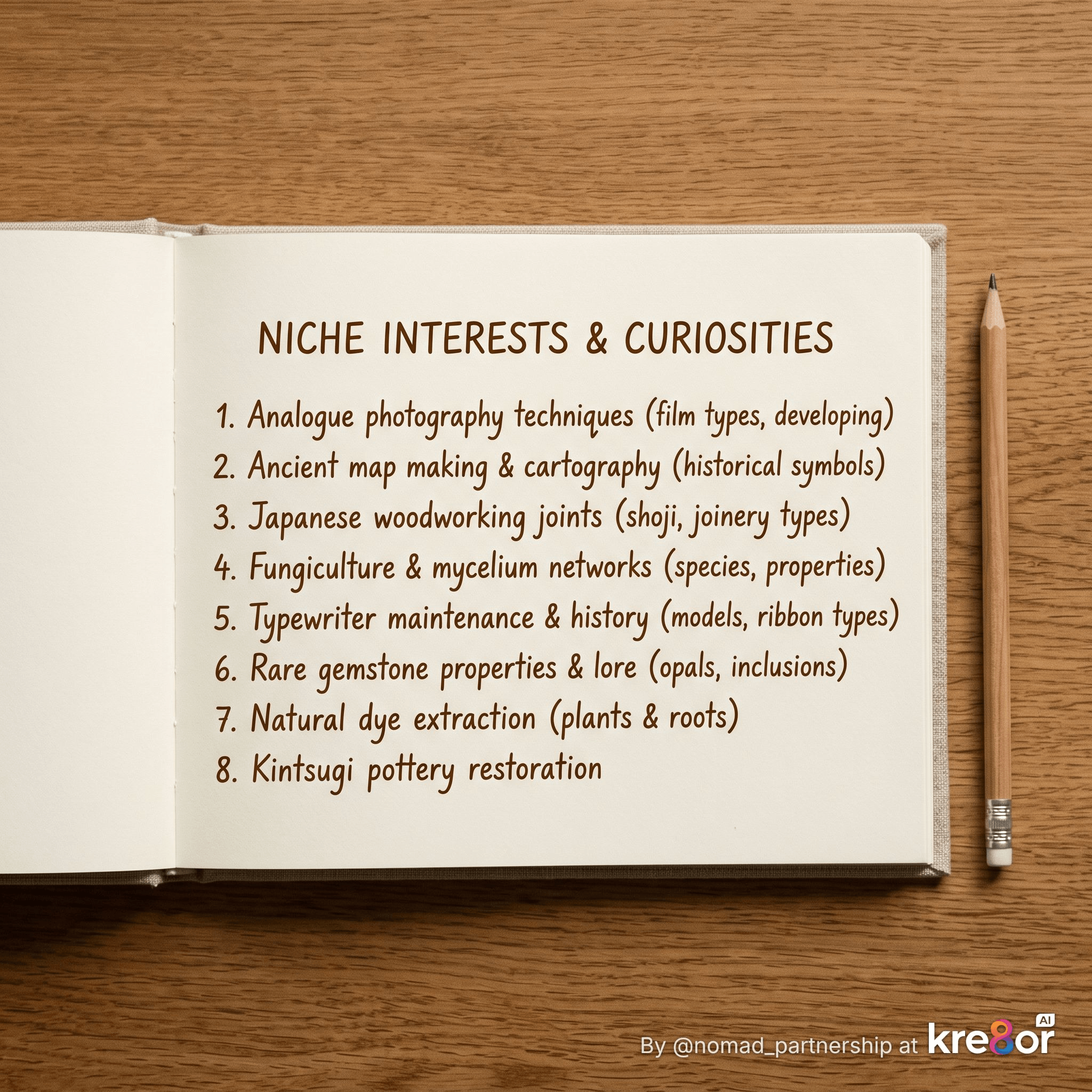
Grab a notebook (or open a blank doc) and list out:
- Topics you talk about naturally with friends or family
- Skills you've developed at work or in your personal life
- Problems you've solved for yourself in the past year
- Hobbies you could talk about for an hour without getting bored
Don't filter at this stage. Just list everything.
Step 2: Check if there's an audience
Take your top ideas and run them through Google. Search for the main question someone in that niche would ask — something like "how do I [thing your niche solves]."
Look at what comes up. Are there other websites, blog posts, forums, and YouTube channels talking about this? If yes, that's a good sign — it means there's an audience. Don't let competition scare you off. A little competition means a real market.
Step 3: Check if there are affiliate products
Go to Google and search: "[your niche] affiliate programme" or "[your niche] affiliate products." See what's available. Look at commission rates and product quality. If you find at least 3–5 decent affiliate opportunities, you're in reasonable shape.
Step 4: Check search volume and difficulty
This is where keyword research comes in. Tools like Jaaxy (which comes free with Wealthy Affiliate) let you check how many people search for specific phrases each month and how difficult it is to rank for them.
You're looking for keywords with decent monthly searches and relatively low competition — so a new site has a realistic chance of showing up in search results.
Step 5: Choose and commit
This is where most beginners stall. They want to find the "perfect" niche before they start. There is no perfect niche. Pick something reasonable, start building, and adjust as you learn.

Common Mistakes to Avoid
Picking a niche just because it pays well
High-commission niches like finance, insurance, and legal services can pay well — but they're also brutally competitive. As a beginner, it's usually smarter to choose something with moderate income potential and realistic competition rather than gunning for the big money from day one.
Picking something too broad
"Fitness" is not a niche. "Strength training for women over 40" is a niche. The narrower you go, the more relevant your content is to the people searching for it — and the faster Google trusts your site as an authority on that specific topic.
Picking something you have zero interest in
You can research a topic you don't love, but you'll struggle to keep going when results are slow (and at the start, they will be slow). Interest matters. It keeps you writing when motivation dips.
Switching niches every few weeks
Affiliate marketing takes time. Most blogs don't see meaningful organic traffic until 6–12 months of consistent effort. If you keep switching niches every month, you'll never get there. Pick something, give it time, and trust the process.
Niche Ideas to Get You Started
If you're drawing a blank, here are some directions worth exploring. These aren't guarantees — just starting points to test against the criteria above.
- Personal finance for recent graduates
- Home gardening and growing your own food
- Remote work setup and productivity
- Beginner photography
- Travelling on a budget
- Dog training for first-time owners
- Home fitness without a gym
- Learning a second language as an adult
- Minimalist living and decluttering
- Ethical and sustainable fashion
The key is to dig deeper. "Home fitness" is still too broad. "Home fitness for people with limited space or equipment" is getting closer.

How Wealthy Affiliate Helps with Niche Research
If you're serious about building a niche website, Wealthy Affiliate is worth a look. It's the platform I used to learn the fundamentals, and niche research is built into its training from day one.
Inside, you get:
- Step-by-step training that walks you through choosing and validating a niche
- Access to Jaaxy, a keyword research tool included with membership
- A community of other beginners and experienced marketers you can bounce ideas off
- Hosting, website builder, and content tools all in one place
The free plan lets you get started without a credit card — so you can explore the training and see if it suits your learning style before committing to anything.
Get guided through niche selection in Wealthy Affiliate's free beginner training.
Start Wealthy Affiliate Free — No Card NeededThe Bottom Line
Choosing a niche isn't the hardest part of affiliate marketing — but it is the part most beginners spend too long stuck on.
The honest truth: any reasonable niche, with consistent content and a patient approach, has more potential than the "perfect" niche with no follow-through.
Pick something you can stick with. Start creating content. Do your keyword research. Build slowly and steadily.
That's the actual path. There are no shortcuts — but there is a process, and it works when you work it.
Got a niche in mind but not sure if it's viable? Drop it in the comments and I'll give you my honest take.
FAQ
Does my niche have to be something I'm passionate about?
Not necessarily. Passion helps you stay consistent, but what really matters is whether you can write helpful content about it for months. Some people build profitable sites in niches they're simply knowledgeable about, not passionate about.
Can I change my niche later?
Yes, but it's better to choose carefully upfront. Switching niches means starting your content library from scratch. Give your first choice a real run — at least 6 months of consistent publishing — before reconsidering.
What are some good niches for beginners?
Niches with consistent search demand and clear affiliate opportunities tend to work well — things like personal finance basics, home improvement, pet care, or specific hobbies. The key is finding a sub-niche within a broader area where you can actually compete as a new site.
How do I know if a niche is too competitive?
Search your main keyword and look at the first page of results. If every result is a major media brand or authority site with thousands of backlinks, that's a tough start. Look for niches where smaller, newer blogs are already appearing on page one — that signals you can compete.
Comments
Notes: Comments are stored locally in your browser (simple, low-maintenance setup).
Be the first to comment.